
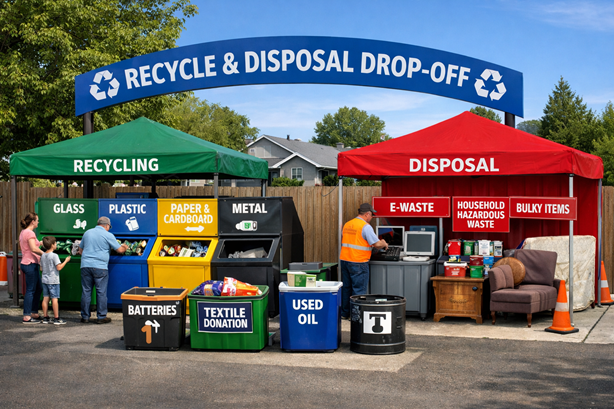
Landfill diversion keeps usable materials out of landfills by recycling, composting, and redesigning how you use and discard things. You can shrink your contribution to landfill growth and save resources by adopting practical diversion steps that fit your daily routine or business operations.
This article explains what landfill diversion means, why it matters for the environment and your bottom line, and which proven strategies deliver the biggest impact. Expect clear, actionable options you can apply at home, in your community, or within your organization to reduce waste and recover value.
Understanding Landfill Diversion
Landfill diversions means redirecting materials away from landfills through reuse, recycling, composting, combustion with energy recovery, or industrial reuse. You will learn what diversion covers, how it developed, and the main benefits for your community and operations.
Definition and Core Concepts
Landfill diversion refers to the actions and systems that keep waste out of landfills by recovering value or preventing disposal. You can measure diversion with a diversion rate: the proportion of total waste that is reused, recycled, composted, or otherwise prevented from being landfilled. Common pathways include curbside recycling, organics collection for composting or anaerobic digestion, construction and demolition material recovery, and mechanical/biological pretreatment.
Key terms to track:
- Diversion rate — (diverted tonnage ÷ total tonnage) × 100.
- Source reduction — avoiding waste creation.
- Material recovery — extracting recyclable commodities.
- Residuals — the non-recoverable portion after processing.
You should track tonnage, contamination levels, and end-market destinations to verify that diverted material is truly reused and not later landfilled.
History and Evolution
Landfill diversion grew from mid-20th century waste management, when communities shifted from open dumps to engineered landfills. You saw recycling programs emerge in the 1970s and 1980s as environmental regulation and resource concerns increased. By the 1990s and 2000s, many municipalities added organics programs and construction/demolition recovery to reduce landfill dependence.
Policy changes accelerated diversion: mandates, pay-as-you-throw pricing, landfill bans on particular materials, and producer responsibility laws all shifted behavior. Technological advances—automated sorting, anaerobic digesters, and waste-to-energy plants—expanded options for diverting mixed waste streams. Markets and regulations remain key drivers; when commodity prices fall or policies change, diversion programs must adapt to remain effective.
Benefits of Reducing Landfill Waste
Reducing landfill disposal lowers methane emissions from decomposing organics, helping your greenhouse gas management. You also reduce long-term liability and land use pressure by extending landfill lifespan and delaying the need for new landfill development. That saves public and private funds tied to permitting, remediation, and closure.
Economically, diversion can generate revenue through recovered materials and create local jobs in recycling, repair, and composting industries. Operationally, you can reduce hauling costs and tip fees when less material goes to expensive landfill disposal. Social benefits include improved community health from reduced landfill odors and contaminants, and opportunities to meet regulatory targets or corporate sustainability commitments.
Key Strategies for Effective Landfill Diversion
Focus on preventing waste at the source, capturing organics, recovering valuable materials, and using energy recovery where appropriate. Each approach requires specific actions, infrastructure, and measurement so you can reduce landfill tonnage and control costs.
Source Reduction and Reuse
Target the point where products are designed, manufactured, or purchased to cut waste generation before collection. You can require suppliers to use less packaging, mandate reusable containers for institutional food service, or adopt product-as-a-service models that keep equipment in circulation instead of discarding it.
Implement procurement rules that prioritize durability, repairability, and standardization to simplify spare-part inventories and extend service life. Track purchases and set reduction targets (for example, 10–20% fewer single-use items in 12 months).
Use take-back and repair programs to reclaim materials and rebuild components; these programs reduce disposal volume and lower procurement costs over time.
Composting and Organics Management
Separate food scraps, yard trimmings, and other compostable organics at the source to remove the single largest stream by mass from landfills. You can deploy curbside organics bins, on-site composting in institutions, or centralized aerobic/anaerobic facilities depending on scale and contamination rates.
Train residents and staff with clear signage and contamination rules; monitor loads and apply fines or incentives to maintain >90% purity when possible. Convert captured organics into compost for soil conditioning or into biogas through anaerobic digestion to generate renewable energy and offset fossil-fuel use.
Recycling and Material Recovery
Design collection and processing to maximize clean, marketable material streams: single-stream convenience must be balanced with higher contamination, while dual-stream or source-separated systems can yield higher-quality recyclables. You can evaluate curbside sorting, deposit-return systems for beverage containers, and producer responsibility schemes to shift lifecycle costs.
Invest in material recovery facilities (MRFs) with optical sorters, eddy currents, and manual quality control to improve yields. Track commodity prices, residual rates, and diversion per capita; set targets such as a 30–50% increase in recovered material value through better sorting and outreach over a two-year period.
Waste-to-Energy Technologies
Use waste-to-energy (WtE) selectively when reduction, reuse, recycling, and organics processing cannot handle remaining residuals. You can choose mass-burn incineration with energy capture, gasification, or anaerobic digestion for organic-rich streams; each technology has different emissions profiles, energy outputs, and capital costs.
Assess WtE projects on lifecycle GHG emissions, local air-quality regulations, and tipping-fee economics. Prioritize facilities that recover heat and power or combined heat and power (CHP) to improve efficiency. Maintain strict feedstock controls to avoid diverting recyclable or compostable materials to incineration.